


Regional overview
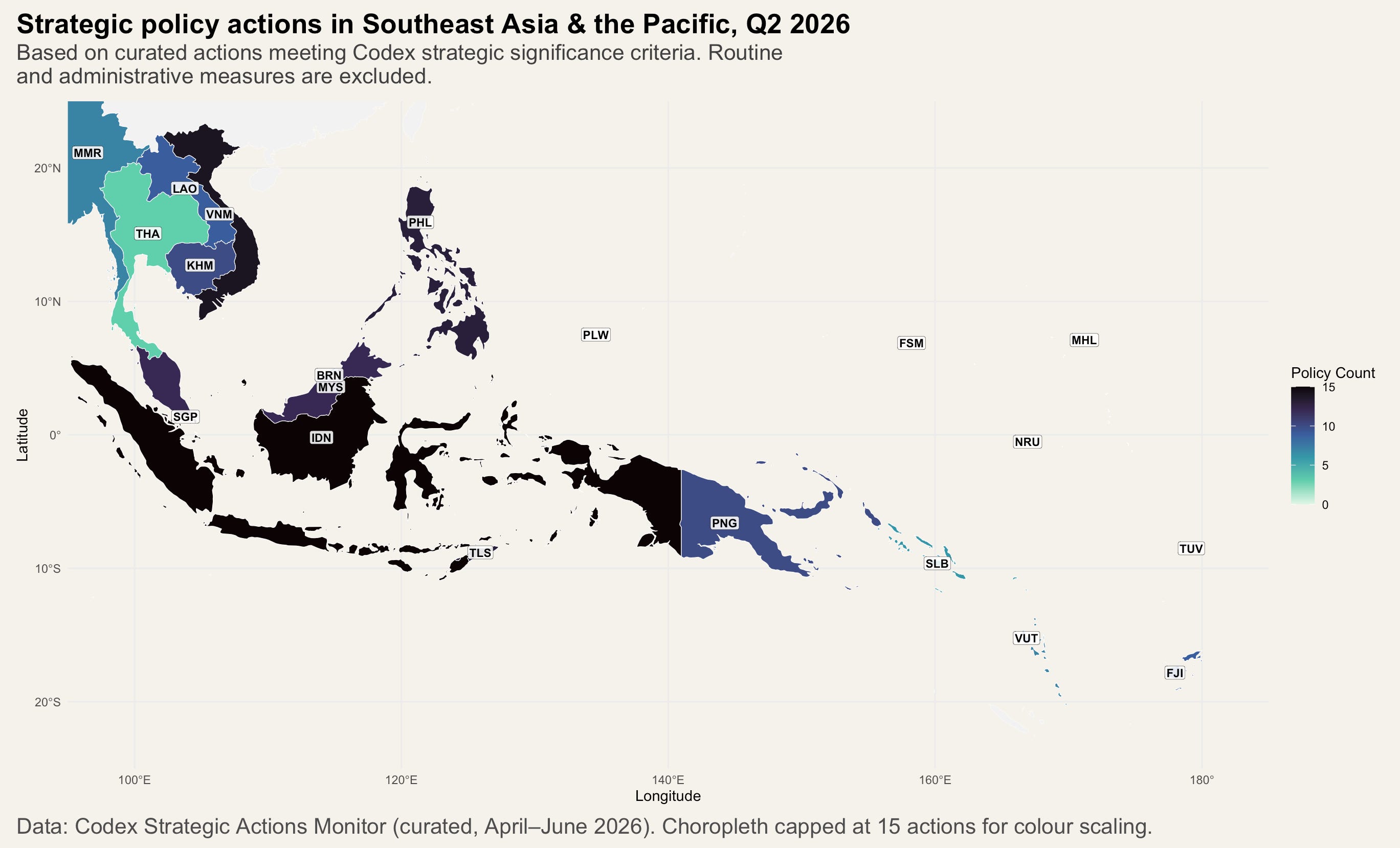
Geographic concentration: Domain composition by region and country
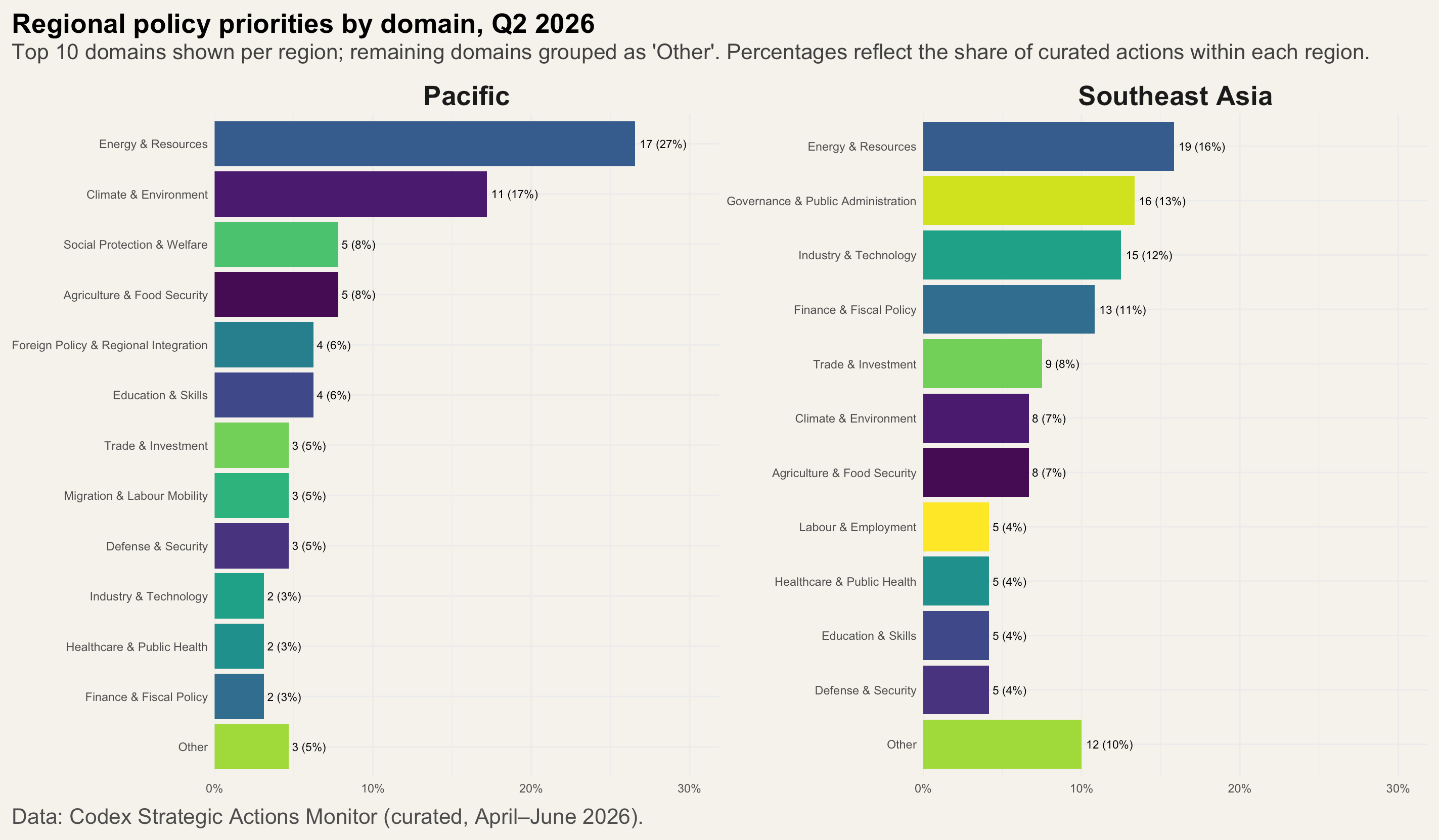
Energy & Resources emerged as the leading policy priority across both the Pacific and Southeast Asia in Q2 2026, although the concentration was substantially stronger in the Pacific. This is shift from the Q1 picture, when the Pacific recorded only 9% of its policy actions in the Energy & Resources domain. By Q2, this had risen to 27%, making Energy & Resources the Pacific's largest recorded policy domain, followed by Climate & Environment at 17%. Southeast Asia showed a broader distribution of priorities: Energy & Resources accounted for 16% of recorded actions, followed by Governance & Public Administration (13%), Industry & Technology (12%), and Finance & Fiscal Policy (11%).
The shift coincides with heightened regional attention to energy security following disruptions associated with the Strait of Hormuz. Codex's Q1 2026 briefing had already identified an early Southeast Asian policy response to the crisis, while the Pacific's recorded actions at the end of Q1 remained more concentrated in Social Protection & Welfare. By Q2, however, energy-related measures had become substantially more prominent in the Pacific's policy record. A Fisher's exact test (p = 0.0041) indicates a statistically significant association between region and the distribution of recorded policy actions across domains, suggesting that the two regions did not exhibit the same pattern of policy prioritization in Q2.
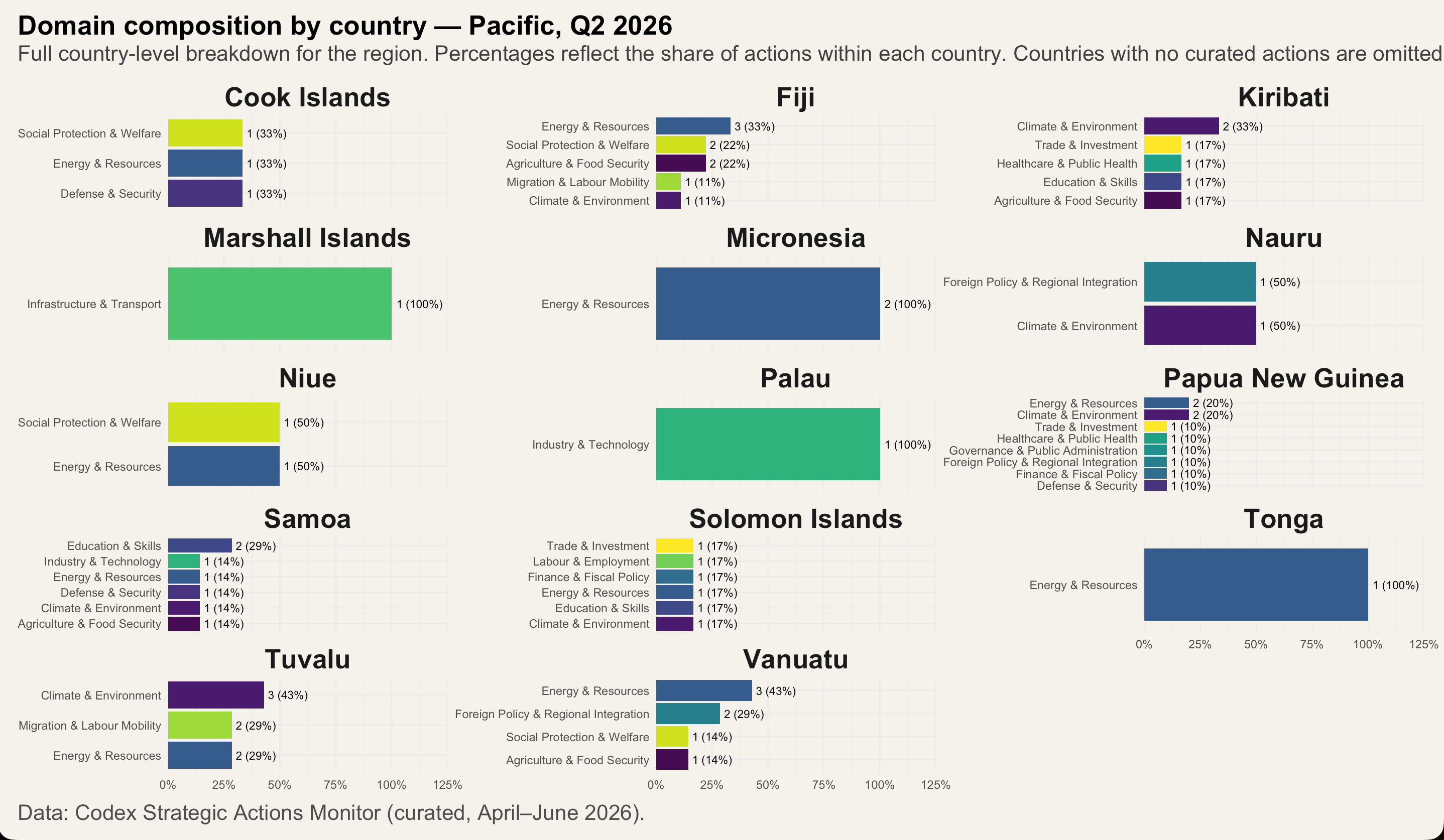
At the country level, a Fisher exact test finds no significant association between individual countries and their dominant policy domains (p = 0.588). This null result is partly driven by data sparsity: the Marshall Islands, Palau, Micronesia, Tonga, and Nauru each contributed only one or two curated actions, leaving insufficient power to detect country-specific clustering. Consequently, while the regional portfolio shows clear thematic structure, disaggregating by country yields no statistically robust domain “signatures.”
That said, Energy & Resources is the most widely represented domain across the sample. It appears in the portfolios of ten of the fourteen countries shown—including Cook Islands, Fiji, Niue, Micronesia, Vanuatu, Papua New Guinea, and Tonga—and in several cases constitutes the sole or largest category (e.g., Micronesia and Tonga at 100 %, Niue at 50%, Vanuatu at 43%). This breadth suggests that energy security and fuel-price management were a near-universal priority in Q2 2026, even if the test cannot isolate a single country as an outlier. Notable examples from the underlying actions include fuel-stabilization measures in Papua New Guinea and Micronesia, and Tuvalu’s declaration of a state of public emergency in April.
Climate & Environment, rather than dominating individual country portfolios, appears consistently as a secondary or shared priority. It is the leading domain only in Kiribati and Tuvalu, yet it registers across a wide geographic spread.
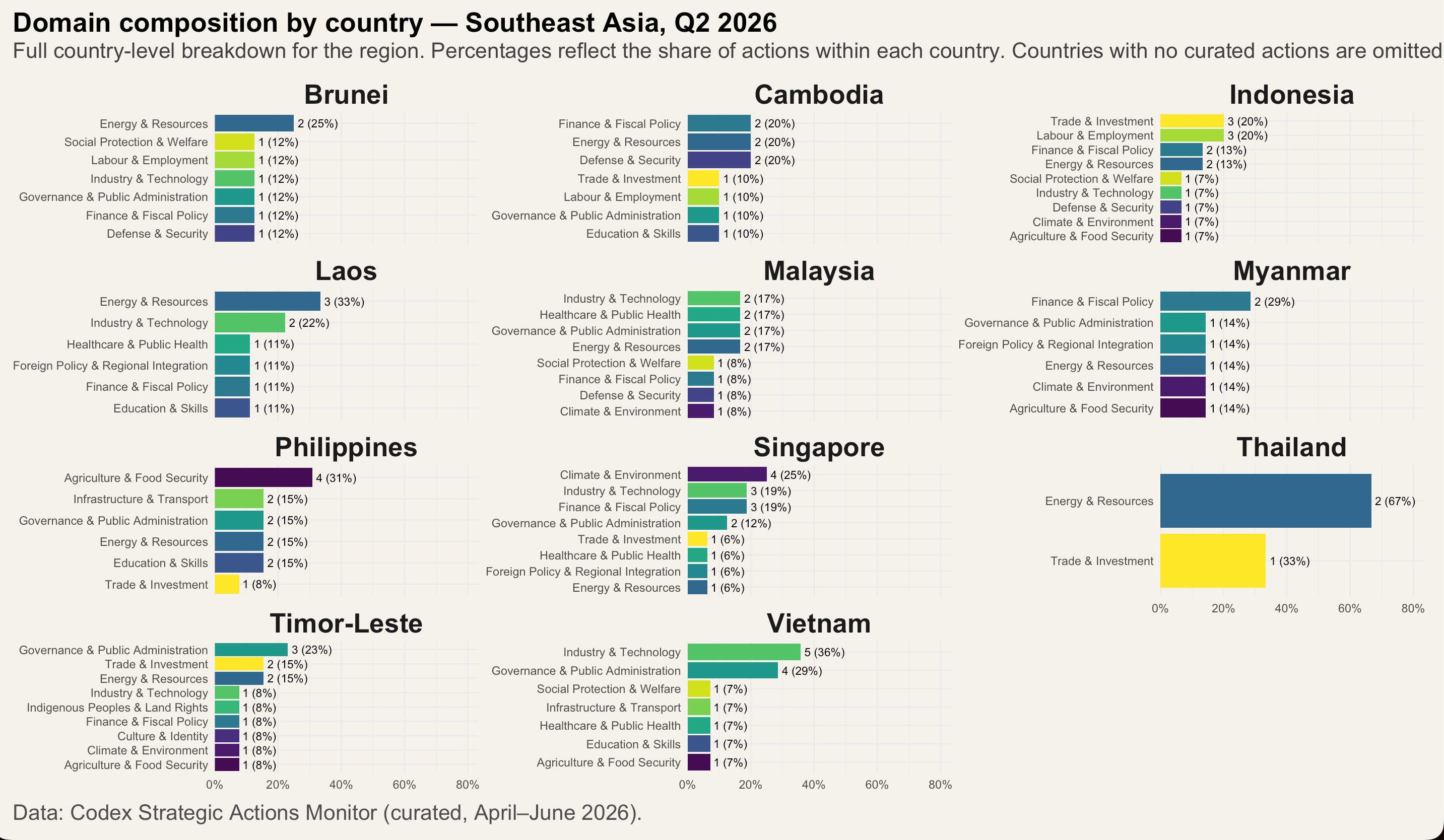
The same pattern holds in Southeast Asia: a Fisher exact test finds no significant association between individual countries and their dominant policy domains (p = 0.106). However, unlike the Pacific the absence of association is driven less by small samples than by thematic diffusion: Malaysia, Cambodia, and Indonesia all show tied or flat leadership across four to nine domains, while even concentrated cases like Vietnam still spread their remaining actions across six sectors. Energy & Resources is the most widely represented domain but it is the unambiguous leader in only three (Laos, Thailand, and Brunei). The one constant across the region is Governance & Public Administration, which appears in ten of eleven countries, suggesting that institutional and administrative reforms provided a baseline layer beneath the noisier sectoral agendas of Q2.
Regionally, Energy & Resources is the most frequently recorded domain, yet it accounts for only 16% of all curated actions—a diffuse footprint rather than a dominant theme. The domain leads or co-leads the portfolio in five countries—Brunei (25%), Cambodia (20%, tied), Laos (33%), Malaysia (17%, tied), and Thailand (67%)—but it is marginal in Singapore (6%) and entirely absent from Vietnam’s Q2 record. This distribution suggests that, by Q2 2026, emergency responses to the Strait of Hormuz crisis had given way to more normalized, diverse policy agendas across the region.
Vietnam and Singapore sit at the low-energy end of the spectrum. Vietnam recorded no Energy & Resources actions at all, maintaining its Q1 emphasis on industrial policy (Industry & Technology, 36%; Governance & Public Administration, 29%). Singapore devoted just a single action to energy (6%), instead weighting its portfolio toward Climate & Environment (25%), Industry & Technology (19%), and Finance & Fiscal Policy (19%).
The Philippines is the clearest sectoral outlier: Agriculture & Food Security occupies a 31% of its curated actions. Two of these initiatives are partnership-driven, including the Philippines–Laos Agricultural Cooperation Agreement and the Sustainable Agriculture Transformation Program backed by US$1 billion in UK and World Bank financing.
Policy instruments: Variation by region and country
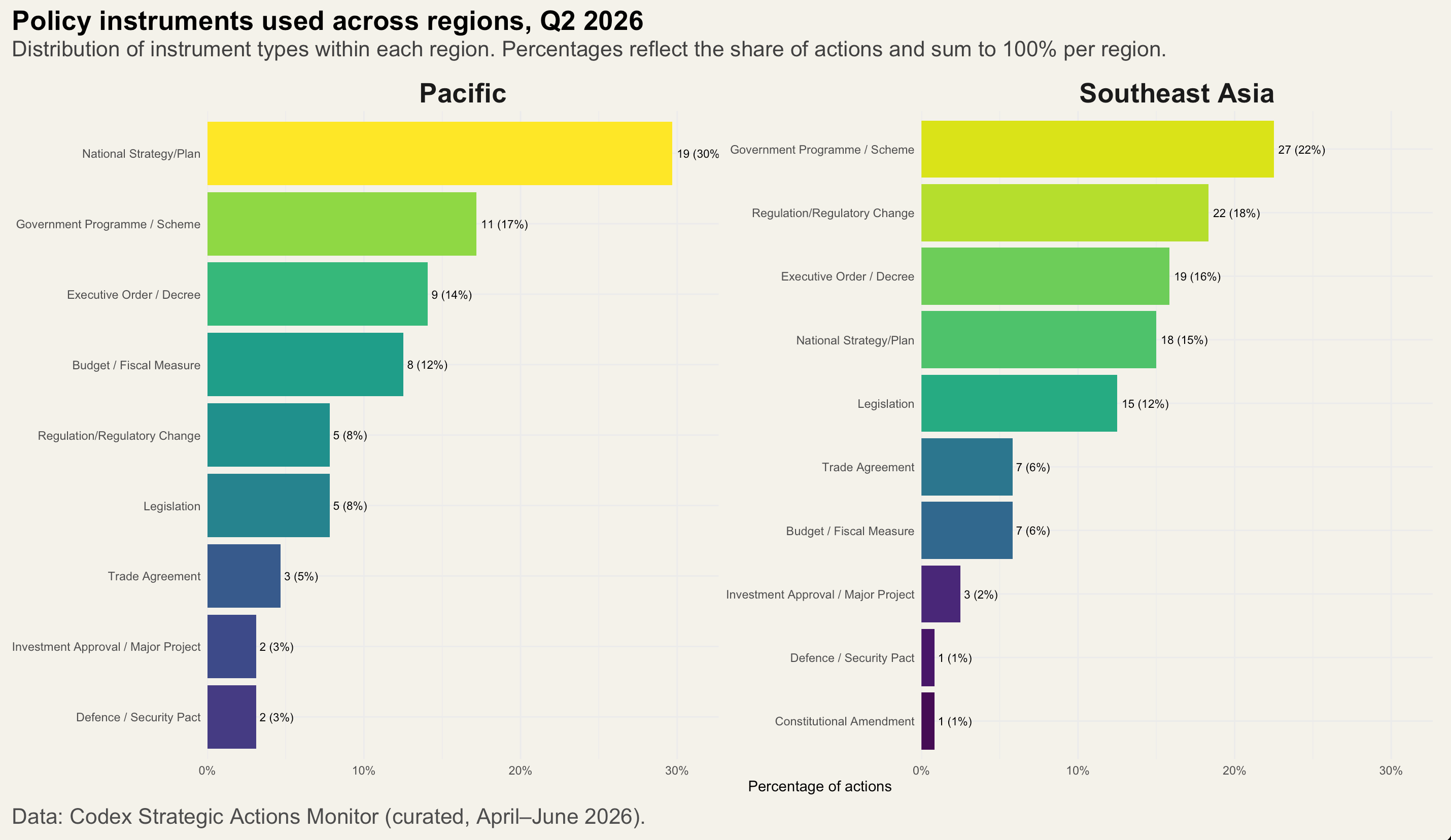
Unlike in Q1, when the Pacific’s dominant instrument was Government Programme/Scheme and Southeast Asia’s was Regulation, both regions have drawn slightly closer together in Q2. Government Programme/Scheme now leads Southeast Asia at 22% of actions, while National Strategy/Plan tops the Pacific at 30%. A Fisher exact test (p = 0.002) confirms this regional association remains significant.
The Pacific’s instrument use has remained largely unchanged. National Strategy/Plan overtook Government Programme/Scheme this quarter (30% vs. 17%), but most others have stayed put: Executive Order/Decree (14%), Budget/Fiscal Measure (12%), and Regulation and Legislation (8% each) all were in similar positions in Q1 2026. Southeast Asia on the other hand had a total flip. Given the end of regular year-start legislative events, policy actions have skewed toward Government programmes, though Regulation/Regulatory Change remains in the top two at 18%. However, the gap between first and second is narrow, at 4%, reflecting a more evenly distributed mix than the Pacific’s.
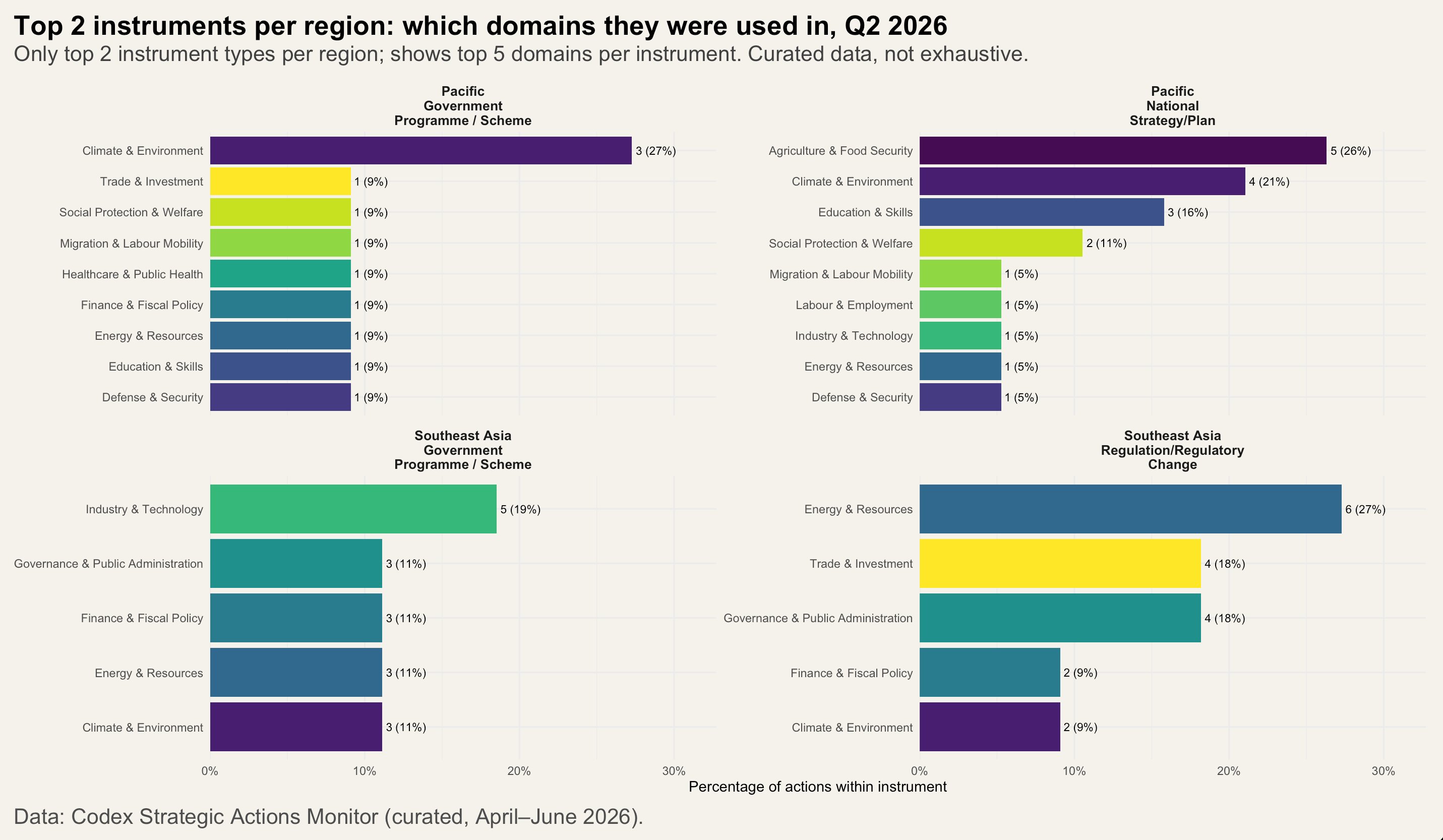
For the Pacific, the top two instruments—Government Programme/Scheme and National Strategy/Plan—have concentrated on three major domains: Climate & Environment, Agriculture & Food Security, and Education & Skills. Climate & Environment is the only domain to achieve double-digit presence in both leading instruments (27% of Government Programmes, 21% of National Strategies), making it a clear regional priority. Agriculture & Food Security dominates National Strategies (26%), while Education & Skills holds a 16% share.
This stands in contrast to Energy & Resources, which registers only a single action in each of the Pacific’s top two instruments despite being the region’s top domain overall. The Pacific’s energy agenda was handled through faster, more flexible tools like Executive Orders and Budget Measures. For example, Papua New Guinea K1 Billion Fuel Stabilization Package implemented in April 2026. The region also holds a diverse number of domains within these top instruments: Government Programs alone touch nine distinct areas, and Social Protection & Welfare recurs consistently across both (9% and 11%), maintaining its place as a steady priority domain.
Southeast Asia has a less diverse domain focus in its top two instruments, but consistent with the region’s broader priorities, Industry & Technology tops Government Programs at 19%, while Energy & Resources dominates Regulation/Regulatory Change at 27%. Trade & Investment and Governance & Public Administration follow closely at 18% each within Regulation. Governance & Public Administration is the only domain to appear strongly in both of Southeast Asia’s top instruments (11% and 18%), suggesting institutional reform runs parallel to sectoral policy. This is a defining feature of the region’s Q2 cycle that has no parallel in the Pacific’s top two instruments.
Editorial pillars: Distribution by region and country
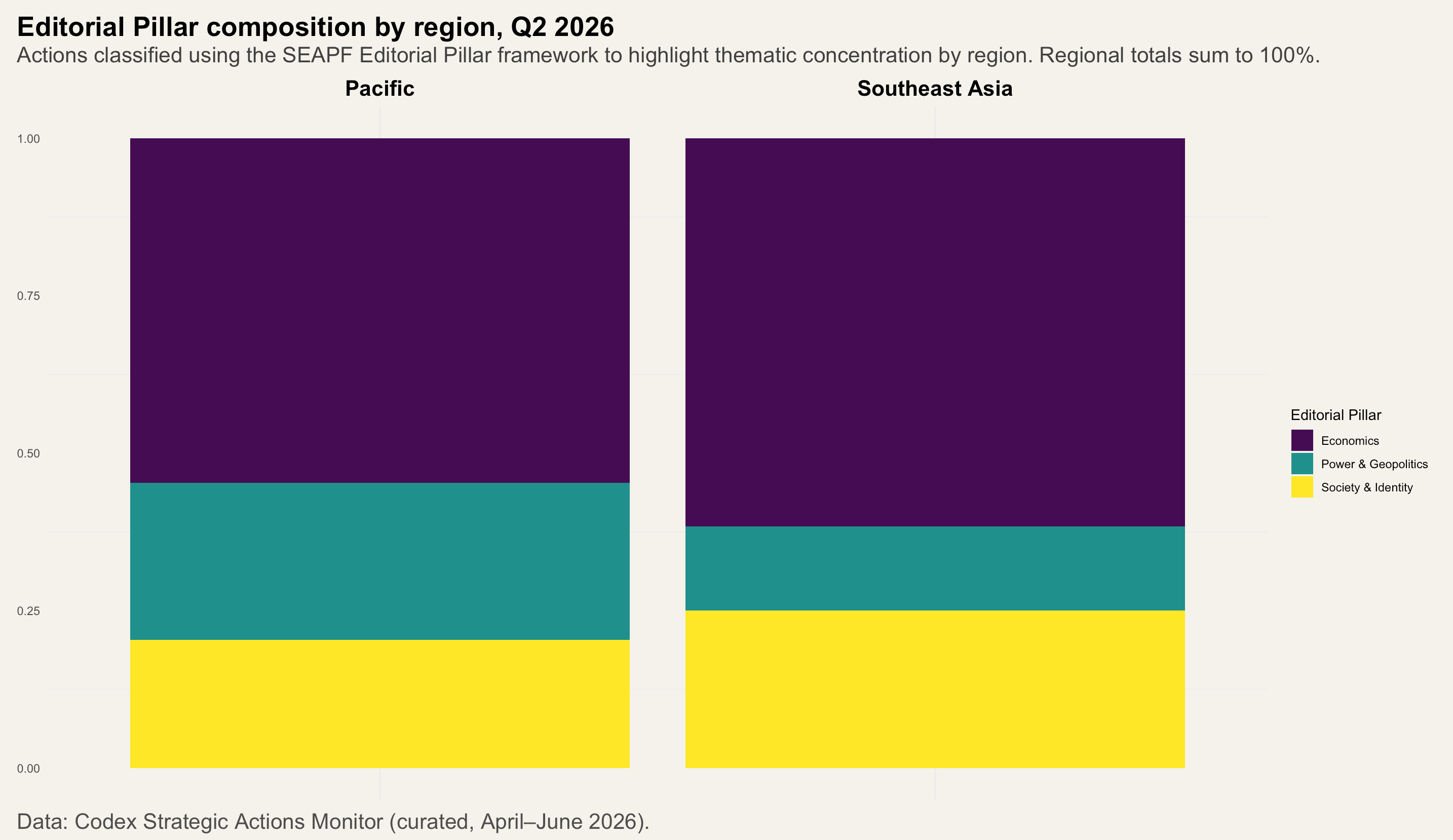
Much like Q1, Economics remains the dominant thematic pillar for both regions in Q2, accounting for roughly 55–60% of all actions. Southeast Asia skews slightly more heavily toward Economics—around 60% versus the Pacific’s mid-50s—with the remainder in Southeast Asia tilting toward Society & Identity (roughly 25%) rather than Power & Geopolitics. The Pacific, by contrast, distributes its non-economic weight more toward Power & Geopolitics. However, a chi-squared test (X² = 4.0023, df = 2, p = 0.135) confirms that this divergence is not statistically significant; the two regions are moving within the same broad thematic space.
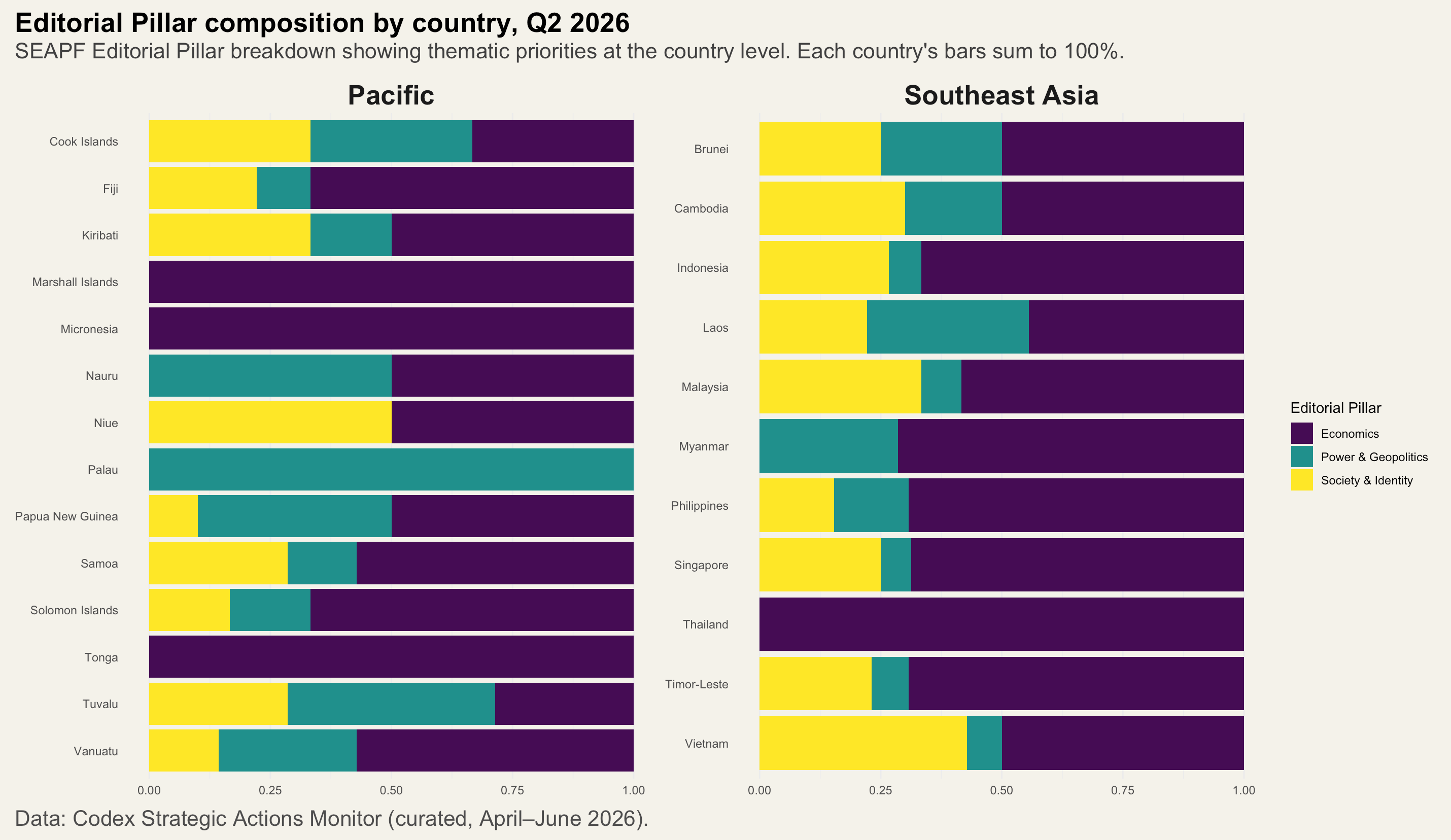
At the country level, Southeast Asia shows Economics as a consistent center. Thailand sits at 100% Economics (with the caveat that Thailand has the least amount of recorded actions), while Indonesia, Myanmar, Singapore, and Timor-Leste all cluster in the high 60s to low 70s. Vietnam is a notable outlier, recording the region’s strongest Society & Identity share which creates a more balanced split with Economics at around 50%. Malaysia and Cambodia also carry meaningful Society & Identity weights. Yet despite these visible variations, a Fisher exact test (p = 0.823) indicates no significant association between country and pillar distribution within the region; the outliers are too few and too scattered to form a coherent sub-pattern.
In the Pacific, while Economics dominates regionally, individual countries range from pure Economics—Marshall Islands, Micronesia, and Tonga all record 100% in this pillar—to near-total absence of it. Palau is an outlier across both regions, with no Economic actions and nearly its entire portfolio concentrated in Power & Geopolitics. This specifically is the April 2026 executive order creating the Palau Office of Applied Technology and Strategy. Nauru and Tuvalu also show substantial Power & Geopolitics shares, while Niue leans heavily toward Society & Identity. Papua New Guinea and Vanuatu display more balanced three-way splits. Nevertheless, a Fisher exact test (p = 0.983) confirms that this country-level diversity does not amount to a significant association; the variation is wide but essentially random rather than clustering into identifiable sub-regional blocs. This may also be due to the low recorded actions within that fit Codex’s strategic methodology.
Methodological Note
The findings in this briefing are based on the Codex Strategic Actions Monitor, a curated dataset of strategically significant policy actions recorded across Southeast Asia and the Pacific. Codex is not an exhaustive record of all government activity. Actions are included only when they meet a defined set of strategic significance criteria—such as major legal or constitutional reform, substantial resource allocation, institutional creation or abolition, or cross-border implications. Routine administrative actions, minor legislative amendments, draft proposals, and other below-threshold events are excluded by design.
This approach reflects a deliberate trade-off. A curated dataset enables consistent cross-country comparison and longitudinal analysis, but it does not capture the full volume of policy activity in any given country. Country and domain counts should therefore be read as indicators of recorded strategic action, not as a ranking of government output. Coverage may also vary across jurisdictions due to differences in government transparency, language accessibility, and source availability.
This briefing reflects analysis by The Southeast Asia Pacific Frontier’s Codex team, based on curated policy actions from Q1 2026. Codex is an evolving project, and we welcome corrections, additional context, or alternative interpretations from researchers, policy practitioners, and those working on the ground. Drop a comment below or get in touch.
