


Regional overview
Key findings
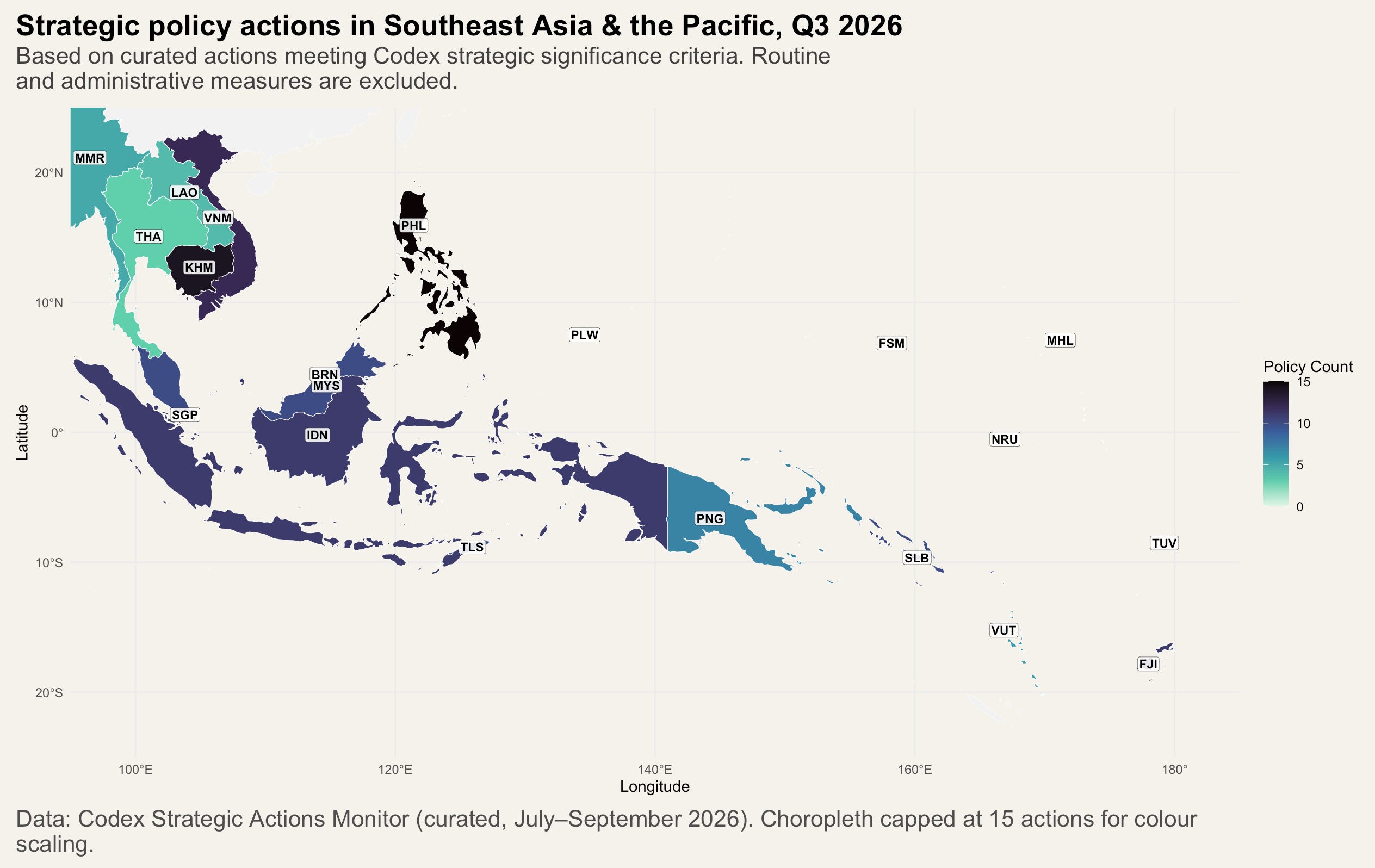
The two regions pursued different policy agendas in Q3 2026. The Pacific focused on fiscal housekeeping and food security, led by Finance & Fiscal Policy and Agriculture & Food Security. Southeast Asia, with more volume, concentrated on industrial and trade capacity, with Industry & Technology and Finance.
Instruments mirror that split. The Pacific leans on planning and budget tools, consistent with caretaker or reactive governance. Southeast Asia relies on “harder” executive tools, led by Regulation and Regulatory Change.
Editorial pillars show no regional difference, and country-level patterns are fragile. Economics leads in both regions and the chi-squared test finds no significant difference (p = 0.85). Country profiles rest on very small counts, so they describe what was recorded this quarter and shouldn’t be read as real priorities.
Geographic concentration: Domain composition by region and country
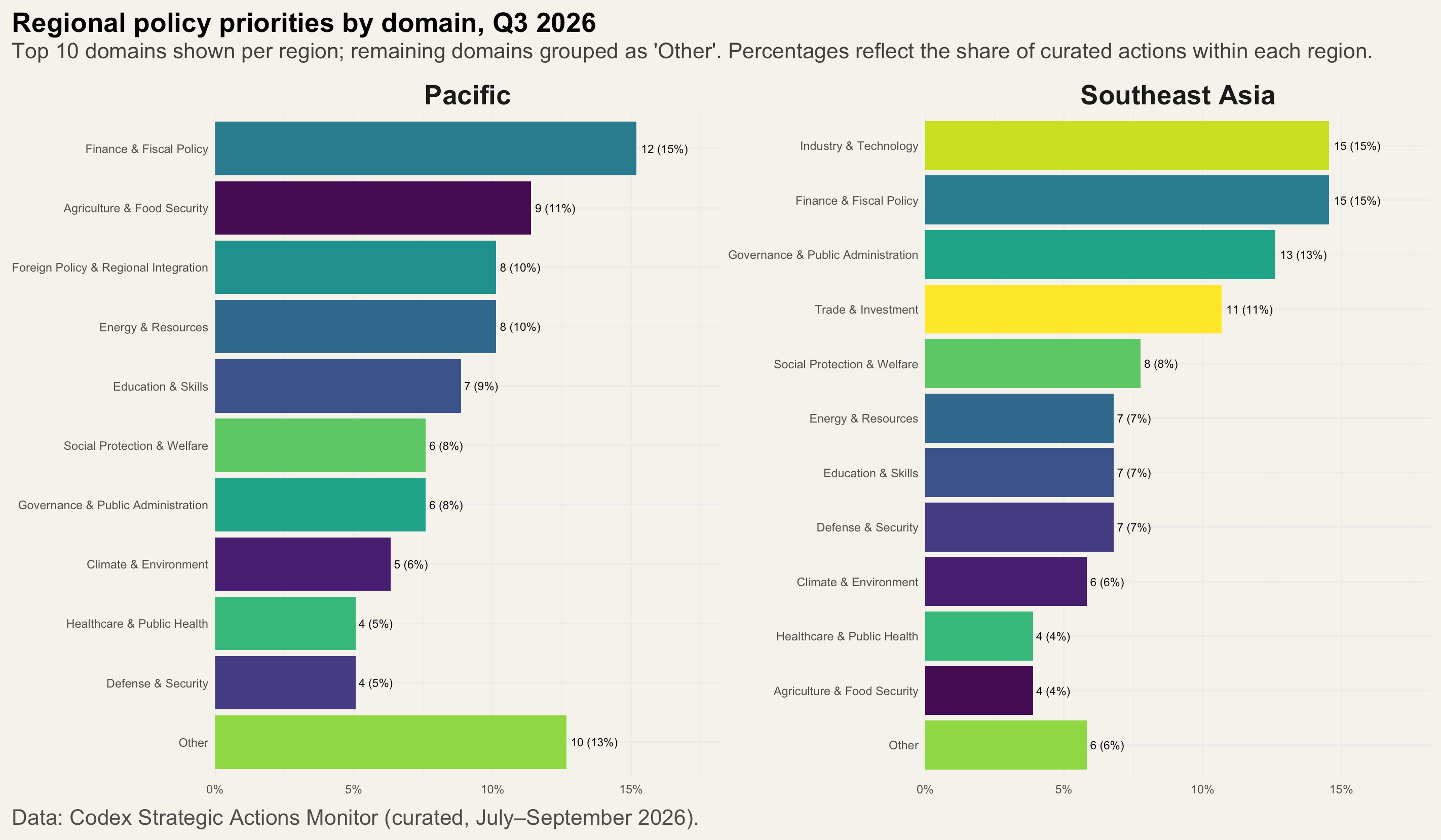
Q3 2026 marked a return to regular policy movement after the Energy-focused Q1–Q2, with the Pacific recording activity across all ten domains. Finance & Fiscal Policy led the region (12 actions, 15%), though the substance was mostly routine — budget measures and other fiscal adjustments. Agriculture & Food Security followed (9 actions, 11%), mostly due to subsidies for farmers and efforts to cultivate fisheries, with Fiji and Vanuatu the most active.
However, the Pacific’s policy agenda is rather flat and reactive. Foreign Policy, Energy, Education, Social Protection, and Governance all cluster within a narrow 6–10% band, and "Other" alone accounts for 13%. And with only ~79 actions recorded, roughly three-quarters of Southeast Asia's total, a shift of two or three policies could reorder the entire ranking.