



When innovation is almost synonymous with digitalization, the global financial system (GFS) has become the cornerstone of digital developments. From continuous regulatory mapping to central bank digital currencies, the prevalence of technological advancements in the GFS is closely linked to efforts in preserving trust through real-time updating systems in databases accessible worldwide.
In daily transactions, these breakthroughs manifest through mobile banking and interoperable quick-response (QR) payments. While these are mainly viewed as a tool of convenience, their ubiquity is a vital indicator of financial connectivity. These integrated digital ecosystems serve as the structural pipelines for modern capital, trade, and tourism. Despite the COVID-19 pandemic accelerating the adoption of these advancements, gaps are continuously present in their implementation across different regions.
While Southeast Asia is in a regional race of introducing breakthroughs in digital finance, cash remains dominant in the Pacific Islands. With the scarcity of QR payment rails at the local level, the region’s fidelity to traditional finance approaches endangers its interoperability, as evidenced by declining correspondent banking connections at the consumer level. If this compounding disconnect persists, a systemic risk of exclusion from the GFS arises, as regional supply chains lose scaling capacity and high compliance costs continue to repel foreign direct investments.
Diagnosing the Pacific regional financial system
An analysis by the IMF underscores geopolitical tensions as a primary driver of global economic fragmentation. However, the geographic configuration of the Pacific Island countries (PICs) alone is enough to instigate fragmentation. Instead of operating as a unified, seamless economic zone, the region’s financial architecture is reduced to thin, isolated markets. At present, fragmentation is materializing at the regional level along three lines: currency zones, financial access, and institutional coverage.
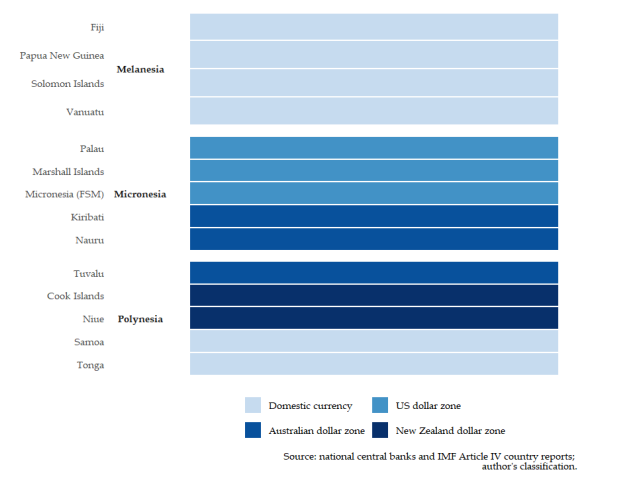
While 42% of the PICs utilize domestic currencies, some utilize other foreign currencies, such as the United States dollar (USD), the Australian dollar (AUD), and the New Zealand dollar (NZD) (Graph 1). As part of the Compacts of Free Association (COFA) agreements with the United States, Palau, Marshall Islands, and the Federated States of Micronesia transact in USD. Meanwhile, due to their small economic sizes, lack of monetary infrastructure, and Australia being a major trade partner, the legal tender of Kiribati, Nauru, and Tuvalu is the AUD. Conversely, the Cook Islands and Niue, being self-governing territories in free association with New Zealand, use the NZD. These disparities in currency zones indicate varying economic and geopolitical alignments with a major power and middle powers, creating a complex landscape of competing donor influences and fragmented regulatory standards, triggering fractures in the region’s financial system. Such inconsistencies establish an unfavorable climate for correspondent banking in the Pacific.
Graph 1: Currencies utilized in Pacific Island countries
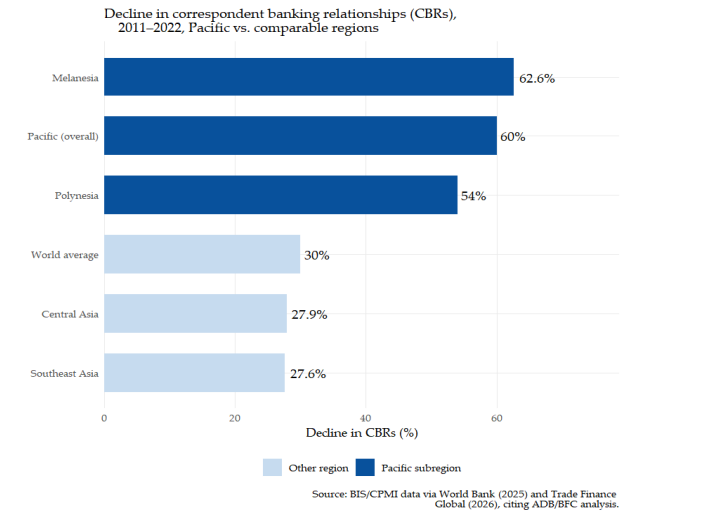
Drawing from graph 2, the overall percentage of decline in correspondent banking relationships (CBR) in the Pacific region is the lowest at 60%, among its neighboring region, Southeast Asia (Δ = 32.4%), the transitioning economy, Central Asia (Δ = 32.1%), and the world average (Δ = 30%). In contrast, the Pacific sub-region of Melanesia has a marginally higher percentage than the main region with a 2.6% difference, while another sub-region, Polynesia’s proportion is slightly lower with a 6% difference.
As illustrated, CBR withdrawal is not a phenomenon that is unique to the region as de-risking became a global trend since the 2008-2009 financial crisis tightened the Anti-Money Laundering and Combating the Financing of Terrorism (AML/CFT) compliance requirements. However, with regional transaction volumes and profits unable to compensate for high compliance costs, the Pacific is cutting ties with major banks at roughly double the rate of the rest of the world. This positions the Pacific as an outlier in the global trend, further supported by World Bank findings flagging the region as highly impacted by bank de-risking. More than a macroeconomic indicator, the decline in CBR shows up at the consumer level through (1) remittance costs getting more expensive, (2) unsustainable trade finance for local businesses, and (3) additional costs and risks for local banks forced into “nested” relationships.
Graph 2: Comparison of percentages of the decline in the correspondent banking relationships among the Pacific and comparable regions
Data scarcity as a significant bottleneck
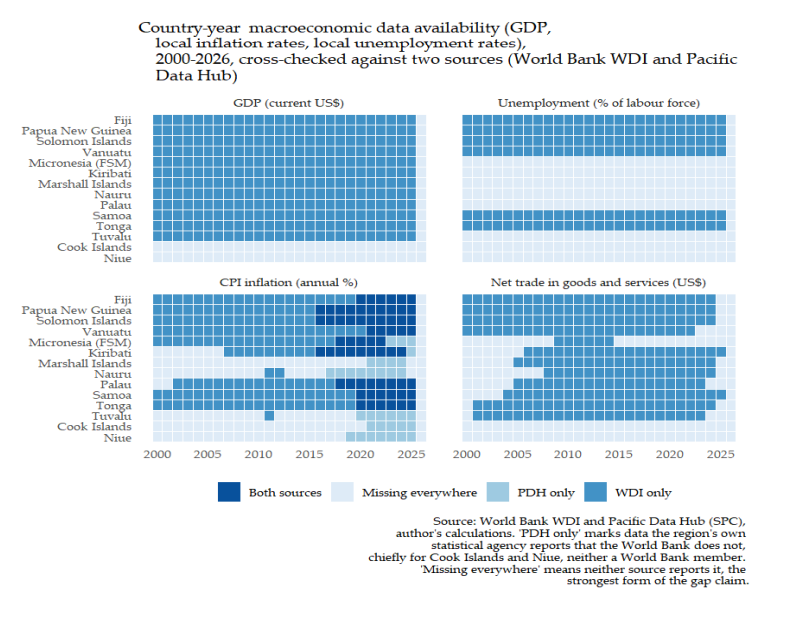
As much as the region is at risk, it is even more difficult for correspondent banks, investors, and negotiators to price the risk accurately or extend credit fairly. Macroeconomic data in the Pacific Islands has become sparse, with the heat map (Graph 3) indicating that the latest actual data available on World Bank’s World Development Index and the Pacific Community’s Pacific Data Hub is dated 2024. Despite GDP being the most reported quarterly indicator globally, reported data across all countries regionally has lagged behind. Operating with paucity in statistics leaves little area for external partners to analyze the current state of the regional economy, affecting decisions on foreign direct investments (FDI) and credit ratings.
Furthermore, when PICs negotiate trade agreements, it is difficult to compare domestic figures due to unavailable aggregating data, creating a structural disadvantage that goes beyond political weakness. Moreover, as supply chain links require trade and logistics data to plan around, inconsistent data reporting, which is visible in Graph 3, weakens the credibility of a region and discourages multinational companies to route any pathway through there, regardless of whether the underlying fundamentals are operating normally. These interconnected issues produce a bottleneck that further reduces the economic activity and institutional capacity needed for efficient data infrastructures.
Graph 3: Heat map of macroeconomic data availability in the Pacific Island Countries (2000-2026)
To address this issue, the Statistics for Development Division of the Pacific Community formulated the Strategic Framework for Pacific Statistics 2022-2030, a long-term plan that “sets the vision, outcome, pathways, and key focus areas” to improve the region’s statistics system. On September 24-25 2026, the Pacific Statistics Standing Committee, a sub-group that plays a central role in implementing the framework, convened in a sixth meeting to review its mid-term progress. While officials mark that regional coordination has strengthened, there remains to be gaps in institutionalization, strengthening data use, and expanding current systems, which they identified as the focus for the second phase of implementation.
Beyond these initiatives, the current statistical scene of the Pacific region is heavily tied with the World Bank. To meet the Committee’s goal of institutionalizing the developments, it is important to ensure the regional ownership of methodology and infrastructure, and the external assistance remains transitional and as technical support. Additionally, strict adherence to the 2025/2027 review timelines may amplify headways toward effective Pacific data governance.
Where is the Pacific Island region in the global supply chain?
Transcending financing and data, the position of the Pacific Islands in the global supply chain is one of the best indicators of regional fragmentation and its exclusion from the GFS. While global maritime superpowers such as China, Singapore, and the Republic of Korea score far above the world average score of 100 in the Liner Shipping Connectivity Index (LSCI), the best-connected Pacific nation, Papua New Guinea, reaches only 10.63 (Graph 4), approximately 10% of the basic global baseline. Notwithstanding, the individual LSCI of PICs exhibit high dispersion, with Niue having the lowest index, whose LSCI sits roughly at one-tenth of Papua New Guinea’s.
Graph 4: Comparison of liner shipping connectivity index, as of 2024, among Pacific Island Countries
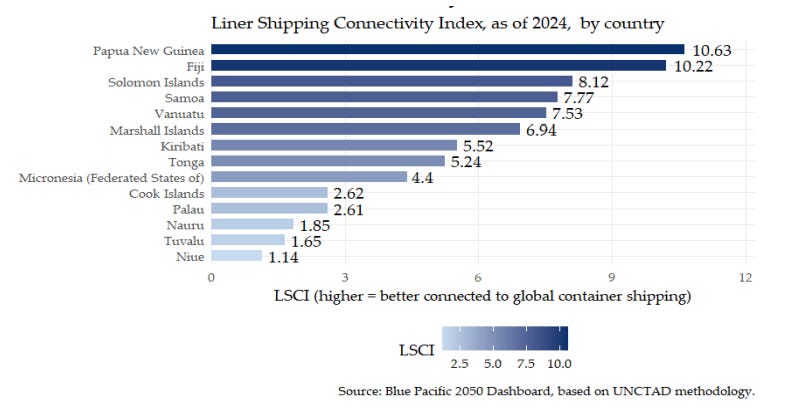
This dispersion is not incidental, but the physical layer of the trade finance and connectivity constraints explicitly drawn from the diagnosis. Weak liner connectivity is directly proportional to longer turnaround times and higher freight costs, which compound the non-tariff barriers already facing Pacific exporters. For firms deciding where to locate processing or assembly within a global value chain (GVC), connectivity of this magnitude is disqualifying before cost or labor considerations are even weighed. The consequence is a regional supply chain integrated on unfavorable terms: micro-states such as Niue and Tuvalu are structurally excluded from most GVC participation, while better-connected economies like Papua New Guinea and Fiji remain tethered to a global baseline they cannot realistically approach. Read alongside the region’s financial and data bottlenecks, this physical constraint completes a taxonomy of exclusion spanning data and infrastructural dimensions, reinforcing each other while demanding distinct policy responses.
Diversification, not in regional direction, but in revenue streams
With the Pacific currently enroute to rewrite their financial system, putting diversification at the core of its strategy might rectify their current situation. They may be able to turn their geographic distance from weakness into an opportunity for growth. Diversification, in this context, must operate on different levels simultaneously. At the national level, individual PICs may move beyond their present concentration in a narrow band of commodities toward export portfolios less exposed to single-commodity price shocks and better positioned within regional value chains. At the regional level, this same logic applies to infrastructure: improving port and maritime connectivity collectively, rather than individually, would narrow the wide LSCI dispersion diagnosed above and give even micro-states a viable path into global shipping networks they cannot pave alone. This strategy can potentially extend to alignment as well, both regionally and bilaterally. Rather than concentrating trade relationships and financial dependencies around a handful of partners, PICs stand to gain from deepening ties across a wider set of blocs and nations, reducing the risk that any single relationship’s withdrawal can destabilize the entire system.
Most of these reforms are achievable if the region pursues them en masse. The Pacific Islands Forum offers the clearest existing vehicle for pursuing these goals as a region, and the present moment may be more favorable than it is presented: as global attention increasingly turns toward Pacific geopolitics, PICs have a rare window to leverage that heightened interest into genuine negotiating power.
The absence of a QR code at a Pacific border crossing, then, is not a footnote to be overlooked. Beyond signaling exclusion, a deeper analysis reveals it can also be an early signal of a financial system still being written. Whether that system excludes the region or is rebuilt to include it on its own terms will depend less on any single reform than on whether diversification, in trade, in infrastructure, and in alignment, becomes the doctrine guiding every choice the region makes from here.
Methodological Note
All visualizations in this article were produced in RStudio (version 4.6.1) using the ggplot2, tidyverse, and WDI packages. Graphs utilizing World Bank data were generated by querying the World Bank’s World Development Indicators (WDI) API directly to ensure the underlying data could be verified or reproduced. Charts drawing on other sources were built from data exported directly from the originating institution’s own database.
This article reflects reporting and analysis made by The Southeast Asia Pacific Frontier. If you have additional context, a different take, or a perspective we’ve missed — whether you’re a researcher, a policy practitioner, or someone living with these realities on the ground — this is an evolving story and we’d like to hear from you. Drop a comment below or get in touch.
About Maria Sofia Castro
Maria Sofia Castro is a Political Economy scholar who specializes in international relations and development. Their work focuses on analyzing how regionalization impacts economic policy and institutional bureaucracy. They currently engage with regional and multilateral organizations to conduct policy research and moderate high-level stakeholder consultations.
