


Regional overview
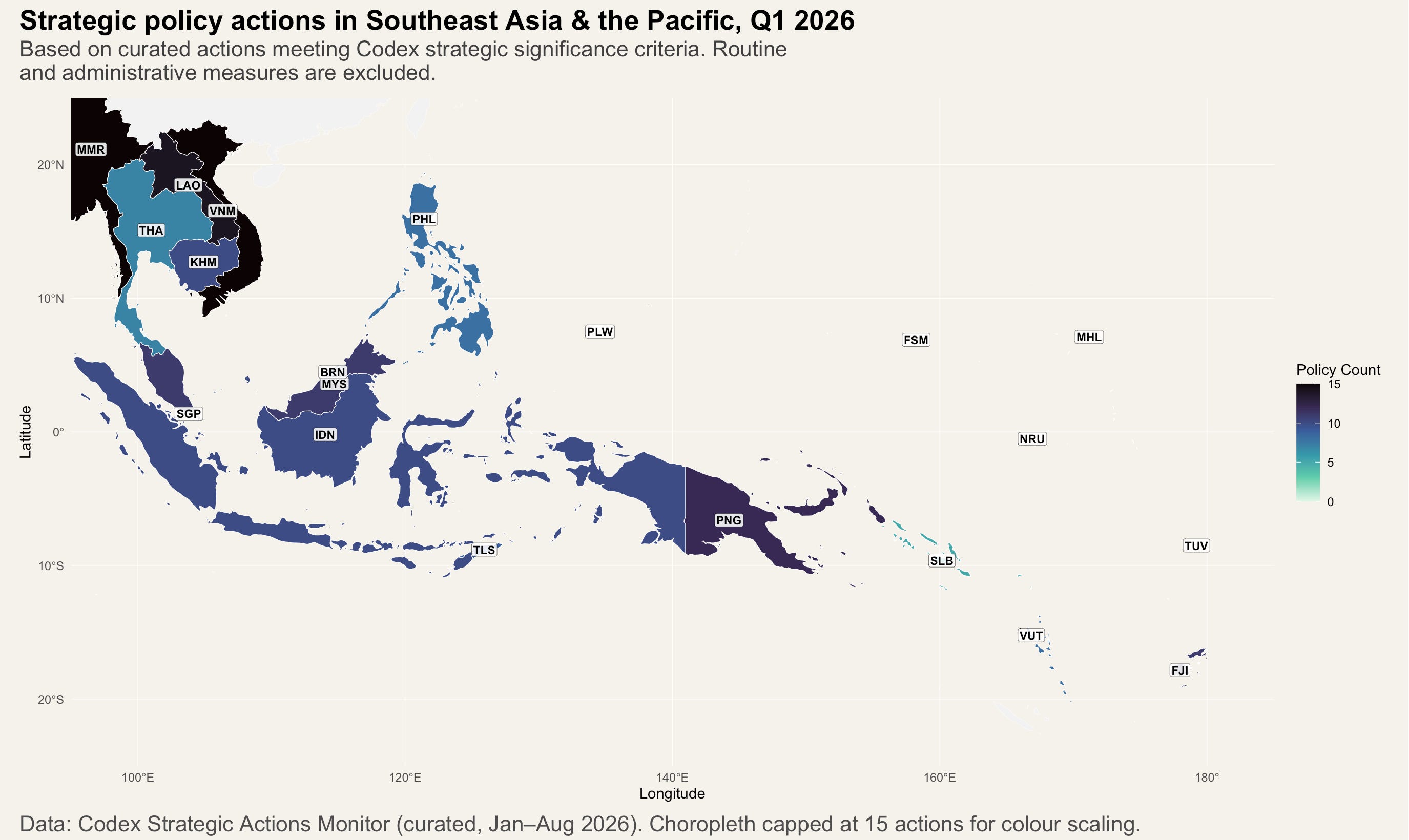
Geographic concentration: Domain composition by region and country
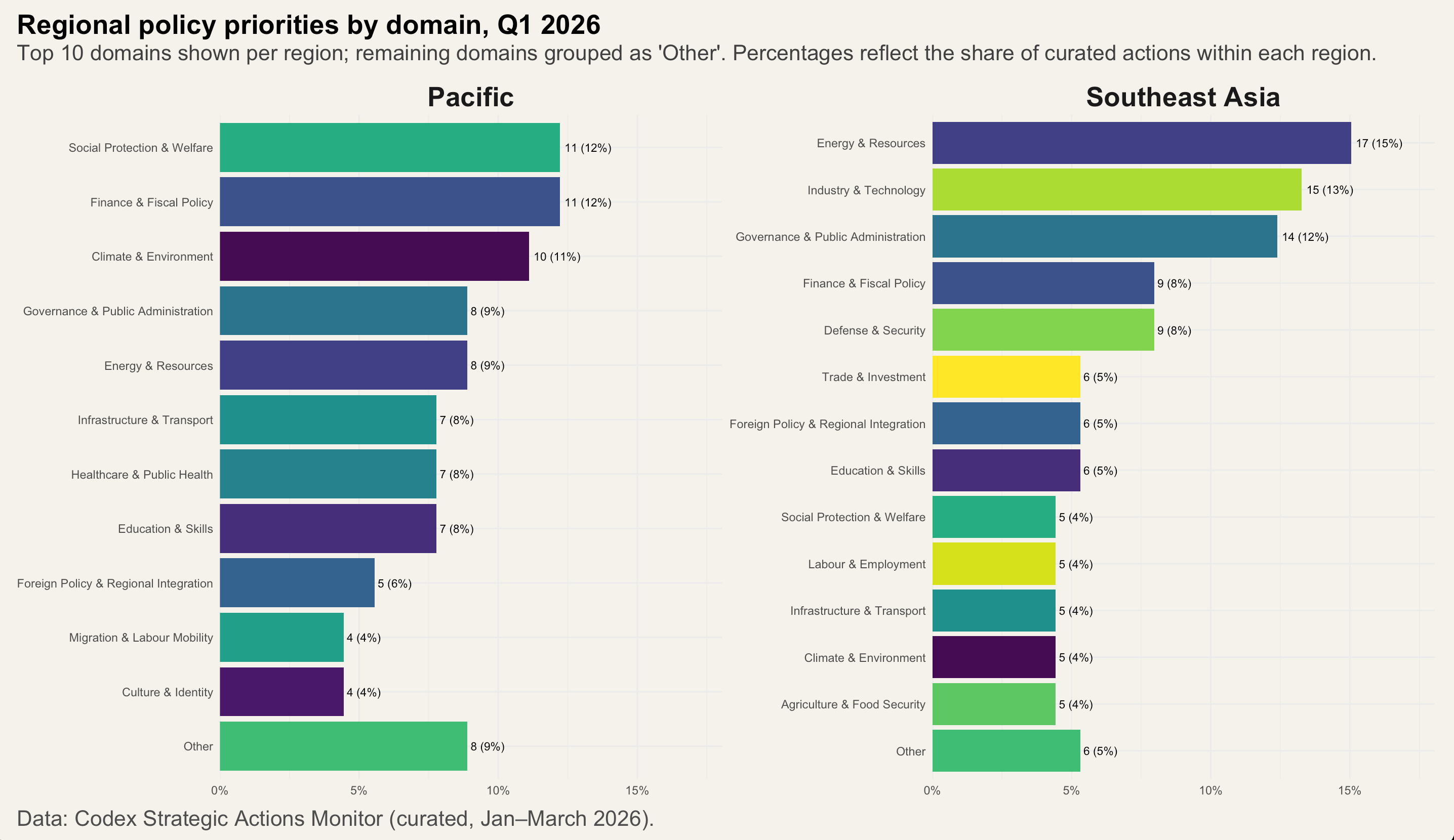
At the onset of 2026, policy activity had only begun to pick up as legislative calendars reset. Implemented measures skewed toward short-term, reactive solutions, but a clear structural divergence separated the regions. A Fisher’s Exact Test (Monte Carlo simulation) confirmed that the divergence in domain composition was statistically significant (p- value = 0.0007999): Energy & Resources concentrated in Southeast Asia (17 actions vs. 8), while Social Protection & Welfare was major Pacific concern (15 actions vs. 5).
This regional “status quo” was disrupted in March 2026. The closing of the Strait of Hormuz triggered a major reordering of Southeast Asian priorities, sharpening the quarter’s reactive character. Energy & Resources vaulted past Industry & Technology and Governance & Public Administration, the early front-runners reflecting regular start-of-year activity, to become the region’s leading domain at 15%.
The shift, however, was not uniform across Southeast Asia. A country-level Fisher’s Exact Test (Monte Carlo simulation) returned a non-significant result (p = 0.2035), meaning that the curated dataset does not provide sufficient statistical evidence to establish a systematic relationship between country and policy-domain composition in Southeast Asian countries. Policy activity remained distributed across a diverse range of domains, even though some countries showed strong concentrations in Energy & Resources.
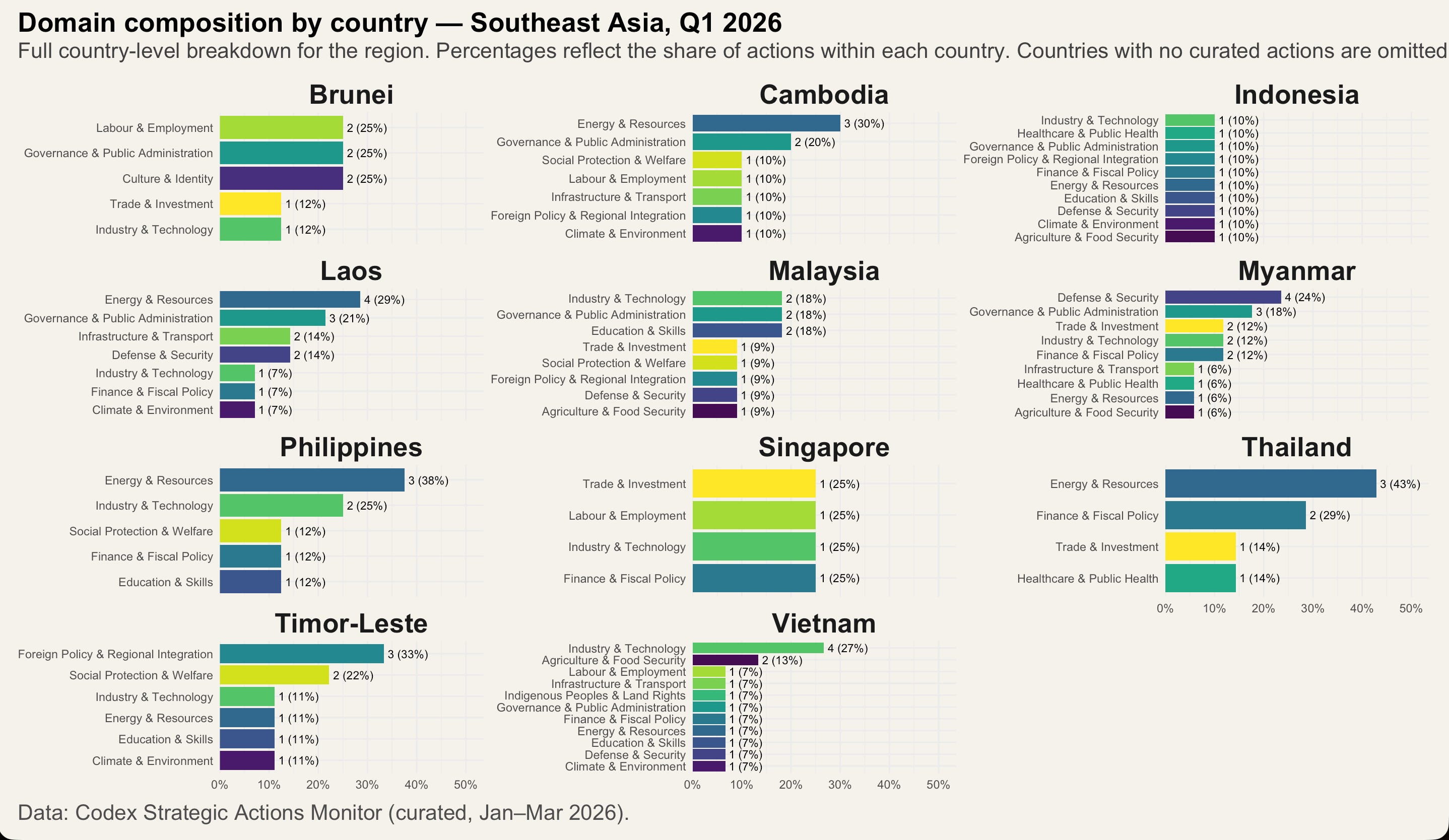
Four countries drove that reordering: Cambodia, Laos, the Philippines, and Thailand each returned Energy & Resources as their largest domain, and by a wide margin - 30%, 29 %, 38%, and 43 % of curated actions respectively. The response in most cases was immediate and executive. Cambodia and the Philippines issued energy-saving measures by decree in the days following the closure; the Philippines and Laos cut office and school weeks at the end of March; fuel tax cuts and suspensions followed across the group. The Philippines went furthest, declaring a state of national emergency. Industry & Technology was the dominant early-quarter focus, consistent with the region-wide ranking above.
Indonesia, Malaysia, and Vietnam show no dominant domain at all. Indonesia's curated actions split evenly across ten domains at 10% each; Malaysia ties Industry & Technology, Governance, and Education & Skills at 18%; Vietnam's Industry & Technology lead (27%) sits atop a flat distribution of 7% shares across nine other domains. None of the three shows the concentrated Energy spike seen in the Hormuz-responder group, which suggests policy activity in these countries ran on pre-existing legislative tracks through Q1.
Myanmar and Timor-Leste are the region's clearest outliers, each driven by a domestic political calendar. Myanmar returned the highest number of curated actions of any country in the dataset, concentrated in Defense & Security (24%) on the back of the extension of both martial law and the state of emergency at the start of the year, with Governance & Public Administration (18%), largely legislative amendments, trailing behind. Timor-Leste, as ASEAN's newest acceded member, concentrated instead on Foreign Policy & Regional Integration (33%), with the signing of the ASEAN Extradition Treaty among its first acts; Social Protection & Welfare followed at 22%, a profile that has more in common with the Pacific region's priorities than with its Southeast Asian neighbors. It is important to note, however, that the Fisher test found no statistically significant association between country and policy-domain composition across Southeast Asia. These profiles therefore stand out descriptively from the rest of the region, but should not be interpreted as evidence of distinct or specialized national policy regimes.
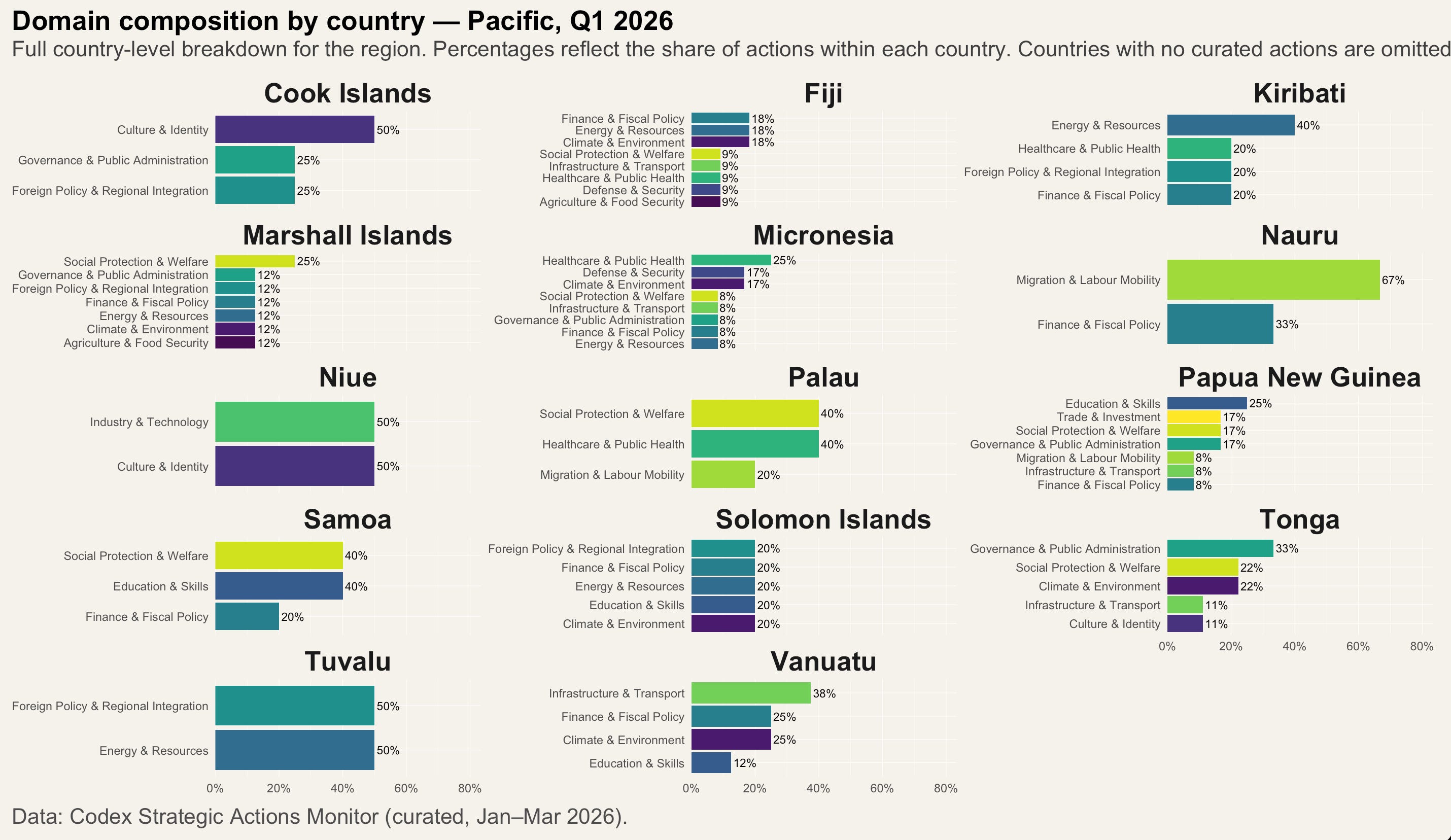
The Pacific bears that comparison out: Social Protection & Welfare is the region's leading domain at 13% of curated actions, ahead of Finance & Fiscal Policy (12%) and Climate & Environment (11%). The data points to a specific focus on child and senior welfare, gender sensitivity, and education. Samoa approved 32.25 million Samoan Tālā (approximately USD 11.91 million) in back-to-school assistance payments in March 2026; Palau opened applications for its Child Raising Subsidy in January. Unlike Southeast Asia, the Pacific's policy response to the Hormuz closure had not yet gathered pace by the end of Q1 — Kiribati and Fiji are the two countries carrying Energy & Resources as a leading domain, but both reflect routine energy activity rather than crisis response, exemplified by Kiribati's Renewable Energy Regulation of 2026.
The Pacific nevertheless exhibits stronger detectable country-level differentiation. A country-level Fisher’s Exact Test returned a statistically significant result (p-value = 0.0332), indicating an association between country and policy-domain composition within the Pacific.
Micronesia, the Marshall Islands, and Palau cluster tightly around Healthcare, Education, and Social Protection—an alignment driven by an external donor-architecture effect rather than organic domestic prioritization. Running a country-level Fisher's Exact Test specifically within this geography yielded a statistically significant result (p-value = 0.0332), ), the significant p-value in the Pacific indicates that its internal variations follow an orderly, predictable pattern. The test confirms that despite small sample sizes for certain islands, Pacific nations are moving along clear, structurally distinct tracks—mathematically separating the baseline, welfare-driven nations from those whose agendas are heavily structured by international donor architectures.
Policy instruments: Variation by region and country
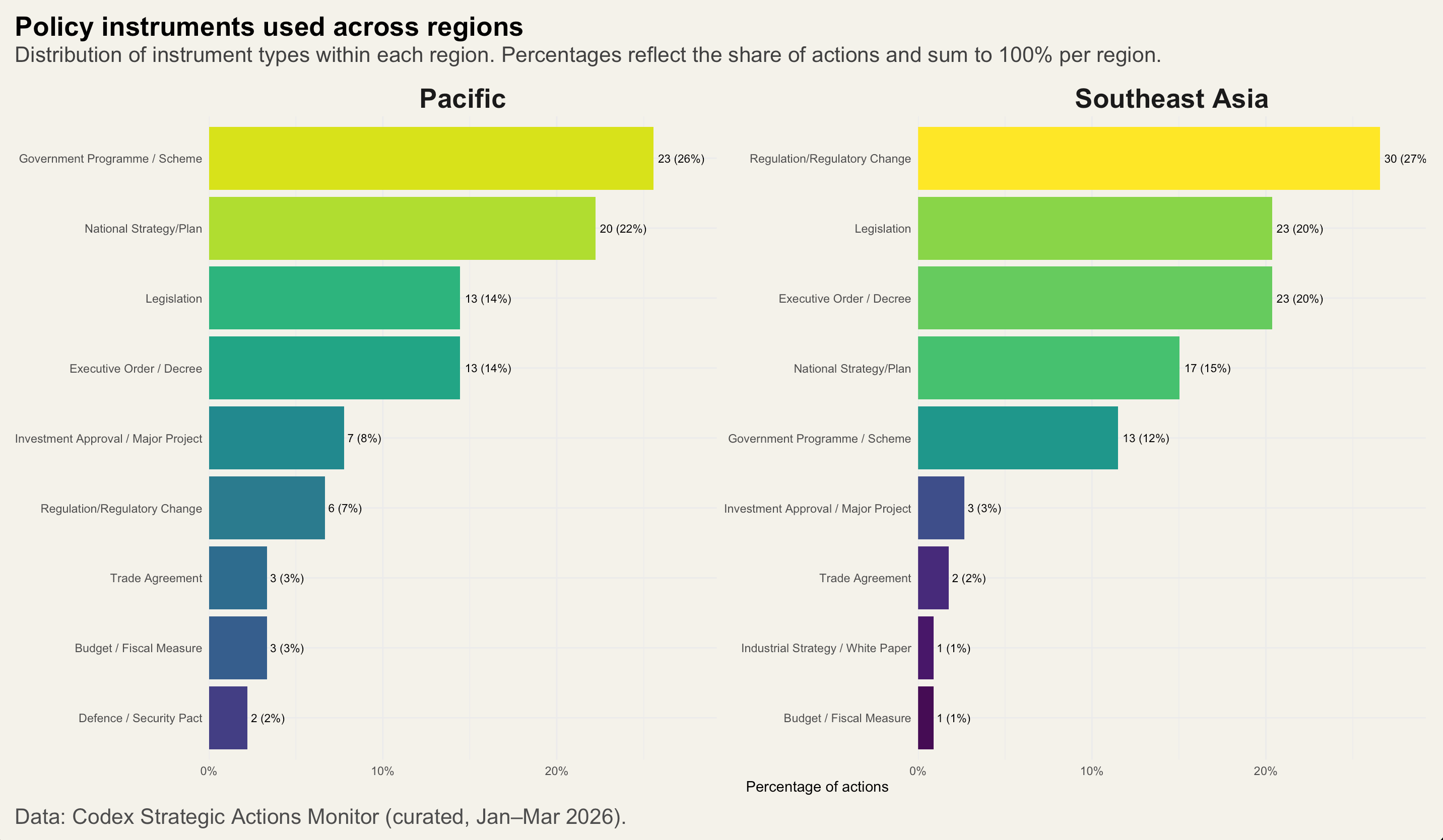
The policy instruments used across the two regions reveal a significant divergence in how priorities were translated into action. A Fisher’s Exact Test with Monte Carlo simulation found a statistically significant association between region and policy-instrument type (p = 0.0002), indicating that the distribution of instruments differed substantially between Southeast Asia and the Pacific within the curated dataset.
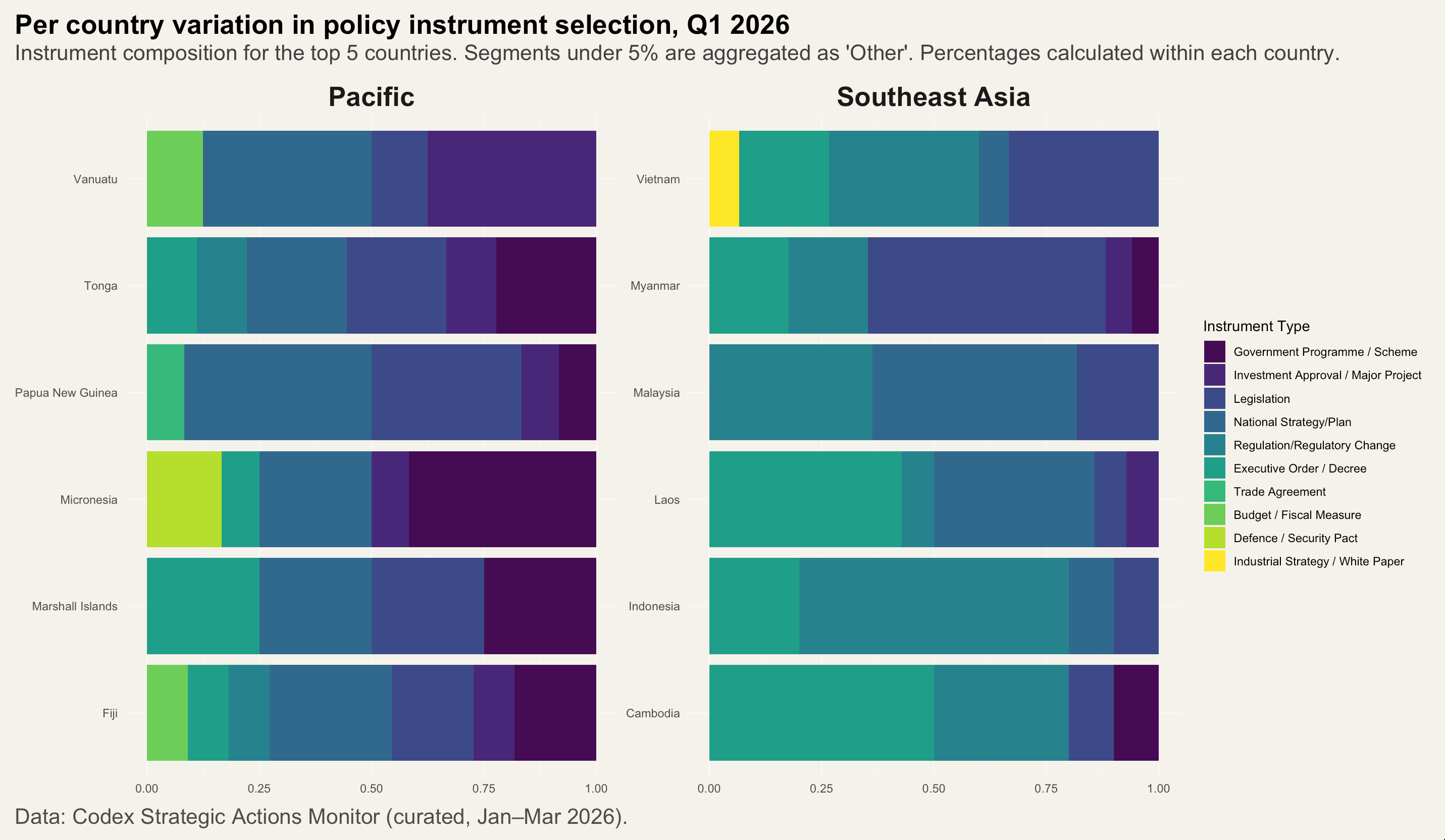
The difference is particularly visible in the balance between programmatic and formal regulatory instruments. In the Pacific, Government Programs/Schemes and National Strategies/Plans together accounted for 48% of recorded actions, making program-based and strategic interventions the dominant mode of policy activity. The Pacific also recorded a higher share of Investment Approvals/Major Projects (8%, compared with 3% in Southeast Asia). Southeast Asia on the other hand had Regulation/Regulatory Change, Legislation, and Executive Orders/Decrees represent 67% of curated actions. Policy activity in the region was therefore much more frequently expressed through formal regulatory, legislative, and executive mechanisms.
This divergence suggests two distinct modes of policy implementation. Pacific governments more frequently articulated interventions through programmes, plans, and major projects, while Southeast Asian governments more often translated policy priorities into formal changes to the regulatory or legal framework. The difference is not simply one of overall policy activity as the four leading instruments account for 76% of Pacific actions and 82% of Southeast Asian actions.
Editorial pillars: Distribution by region and country
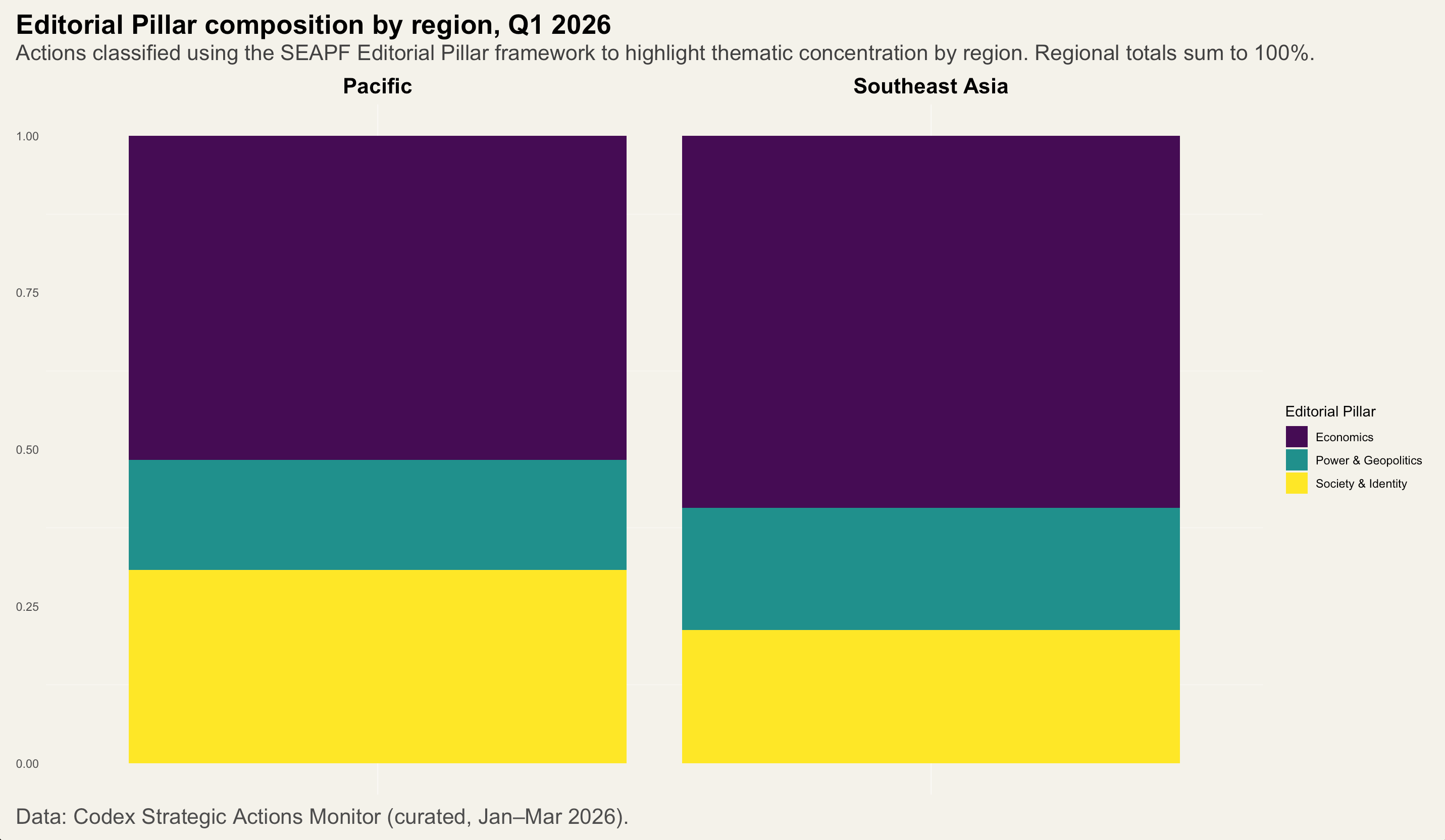
Economics was the dominant pillar in both Southeast Asia and the Pacific this quarter. In Southeast Asia, it accounted for roughly more than 50% of curated actions; in the Pacific, roughly half. Power & Geopolitics and Society & Identity made up the rest in similar proportions across both regions. Visually, the distributions skew heavily toward Economics, with a moderate presence of Society & Identity and a smaller share of Power & Geopolitics. A chi-squared test of independence (X² = 2.0531, df = 2, p-value = 0.358) and a Fisher’s exact test (p-value = 0.376) both show no significant difference in pillar composition between the two regions.
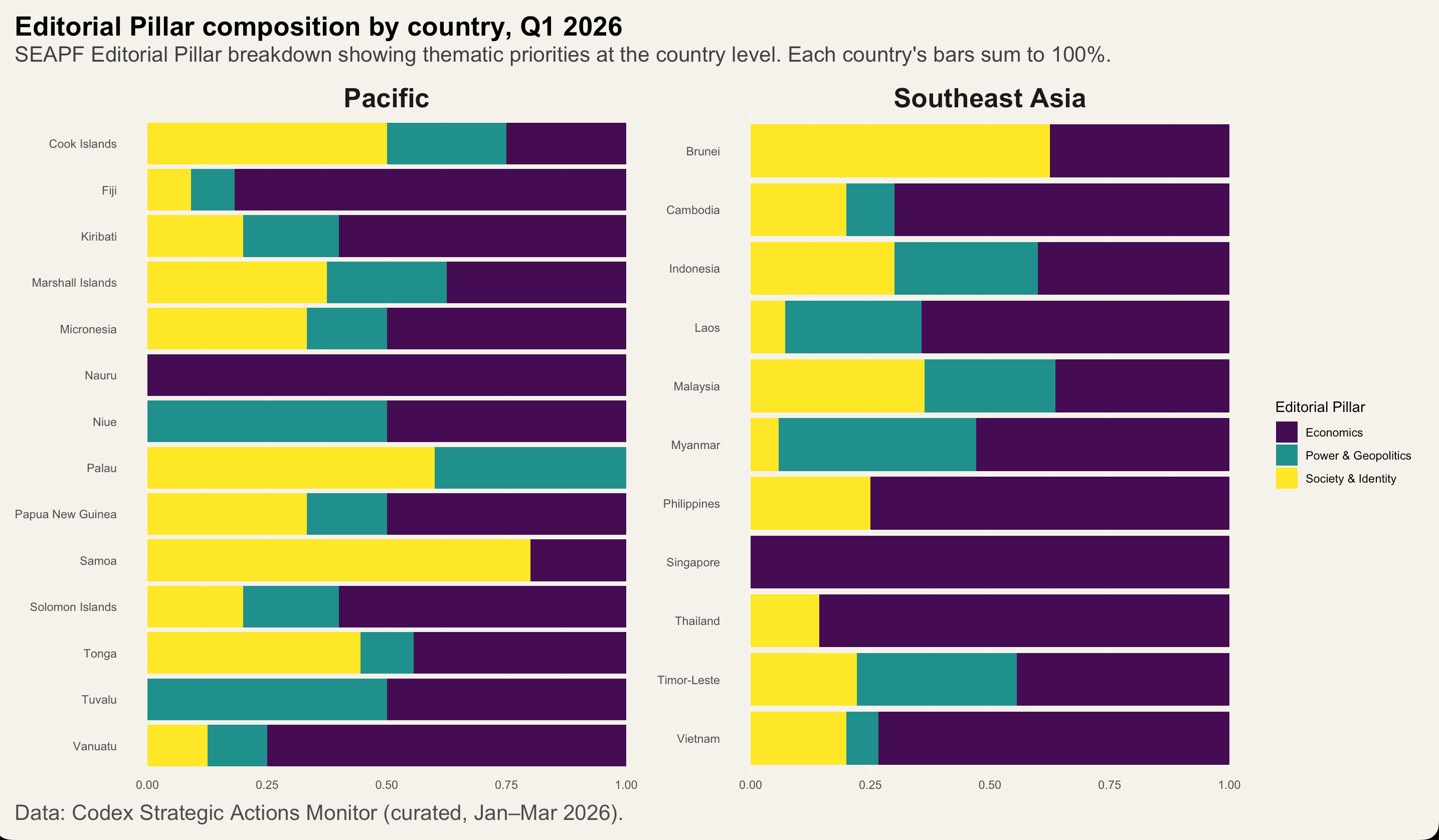
At the country level in Southeast Asia, Brunei, Indonesia, Malaysia, and Timor-Leste had a relatively lower concentration on Economics, with Brunei leaning more toward Society & Identity and Myanmar toward Power & Geopolitics. Despite these variations, Economics remained the dominant pillar region-wide. A Fisher’s exact test (p = 0.062) found no statistically significant association between country and pillar composition. The dominance of Economics is a region-wide fact, not driven by a few outlier countries. The differences between countries are suggestive but not strong enough to say that one country is exceptionally focused on one pillar compared to the others.
The same pattern holds in the Pacific. Palau specifically has no Economics actions in the dataset, while the Cook Islands and Samoa have the smallest numbers. A Fisher’s exact test (p = 0.347) confirms no significant association between country and pillar composition. Here too, Economics leads regionally, but no individual country stands out as exceptionally focused on one pillar.
Both regions show a similar pillar distribution dominated by Economics, with no statistically significant difference between them. Within each region, no individual country stands out as exceptionally focused on one pillar, though Southeast Asia shows borderline variation that may warrant further monitoring with more data.
Methodological Note
The findings in this briefing are based on the Codex Strategic Actions Monitor, a curated dataset of strategically significant policy actions recorded across Southeast Asia and the Pacific. Codex is not an exhaustive record of all government activity. Actions are included only when they meet a defined set of strategic significance criteria—such as major legal or constitutional reform, substantial resource allocation, institutional creation or abolition, or cross-border implications. Routine administrative actions, minor legislative amendments, draft proposals, and other below-threshold events are excluded by design.
This approach reflects a deliberate trade-off. A curated dataset enables consistent cross-country comparison and longitudinal analysis, but it does not capture the full volume of policy activity in any given country. Country and domain counts should therefore be read as indicators of recorded strategic action, not as a ranking of government output. Coverage may also vary across jurisdictions due to differences in government transparency, language accessibility, and source availability.
This briefing reflects analysis by The Southeast Asia Pacific Frontier's Codex team, based on curated policy actions from Q1 2026. Codex is an evolving project, and we welcome corrections, additional context, or alternative interpretations from researchers, policy practitioners, and those working on the ground. Drop a comment below or get in touch.
